Welcome to Hubei Magicleaf Technology Co., Ltd.
Mobile: +8618566295225
E-mail: tina@magicleafbags.com

Mobile: +8618566295225
E-mail: tina@magicleafbags.com
Choosing the right key fob shielding pouch size is not only about whether the key fob can enter the pouch. The key fob must fit inside the intended shielding compartment while still allowing the closure to engage fully and consistently.
A car key fob can vary in length, width, thickness and shape. A protective shell, key ring, emergency key, key chain or attached accessory can also change the usable space required. For this reason, buyers should measure the complete everyday-carry configuration before approving a standard pouch size or requesting a custom size.
This guide explains how to measure a car key fob, calculate closure allowance, evaluate a sample and decide whether a standard pouch format or custom construction is more suitable for an OEM project.
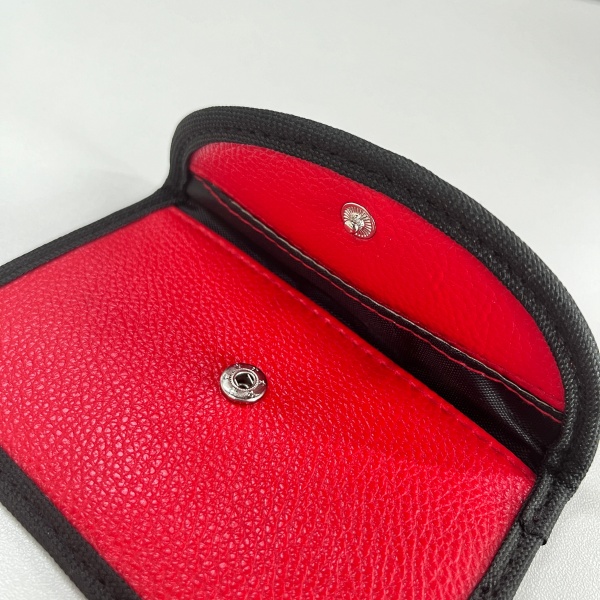
An outside pouch measurement does not always equal the usable internal space. Material thickness, seam allowance, lining structure, fold direction and closure design can all reduce the internal area available for a key fob.
For example, a pouch with an outside measurement of 12.5 × 8 cm may have a smaller usable internal area after seams, folded edges and closure overlap are considered. A key fob that appears to fit by measurement may still sit too close to the closure edge or prevent the shielding compartment from closing completely.
The correct question is not simply, “Will the key fit inside?” The correct question is, “Will the key fob, case and key ring fit inside while allowing full closure in normal daily use?”
Before selecting a pouch size, measure the actual item that users will carry. Do not measure only the bare electronic key fob if the customer will normally keep it inside a silicone cover, leather case, metal key ring or key chain.
For an OEM project, collect dimensions from representative key fob models in the intended market. If the product will be sold across several vehicle brands or regions, use multiple representative samples instead of relying on only one key fob.
| Measurement | How to Measure | Why It Matters | Record Example |
|---|---|---|---|
| Key Fob Length | Measure the longest end-to-end dimension of the complete key fob. | Determines whether the key fob can sit inside the pouch without reaching the closure edge. | 72 mm |
| Key Fob Width | Measure the widest point of the fob body or protective shell. | Helps determine whether the fob can lie flat inside the intended compartment. | 42 mm |
| Key Fob Thickness | Measure the thickest point, including a protective cover if used. | Affects pouch depth, closure overlap and daily handling. | 16 mm |
| Key Ring and Attached Keys | Measure the total thickness and width created by rings, keys or accessories. | Bulky accessories may prevent the pouch from closing fully. | Key ring adds 8 mm |
| Protective Case or Shell | Measure the fob again with the case installed. | A case can increase all dimensions and change the pouch fit requirement. | Width increases to 48 mm |
| Required Closure Allowance | Allow extra space between the stored item and the closure edge. | Supports complete closure and reduces crowding near the shielding opening. | Allow at least 15–25 mm for sample review |
Start with the three main dimensions: length, width and thickness. Use a ruler, digital caliper or measuring tape. Record the largest point for each measurement rather than an average measurement.
For irregularly shaped key fobs, record the widest and thickest areas. A key fob may taper at one end but have a large button section, curved edge or key-ring attachment that creates additional bulk.
If users normally carry a protective cover, attached mechanical key, carabiner, ring or decorative accessory, include those items in the measurement. A pouch that works for a bare key fob may not work when users store the full key setup.
For product development, it can be useful to prepare two measurements:
This gives buyers a clearer view of whether a standard pouch is suitable for basic storage only or for real everyday use.
Many pouch-size problems occur because the key fob itself was measured correctly, but the attached accessories were ignored. A key ring can create a hard point near the closure area. A protective shell can add several millimeters to the width and thickness. A mechanical key can create an uneven shape that changes the way the fob rests inside the pouch.
When evaluating a sample, place the key fob inside in the same orientation that users are likely to use. Then test whether the pouch can close without forcing the key fob, bending the closure edge or creating a gap.
The position of the key ring can be as important as its size. If the ring sits directly under a flap or at the closure edge, it may interfere with complete closure. In some cases, changing the orientation of the fob inside the pouch can improve the fit. In other cases, a larger pouch or revised internal layout may be required.
Closure allowance is the free space needed between the stored key fob and the pouch opening. It gives the closure room to fold, overlap, zip or engage correctly without the key fob pressing directly against the edge.
The exact allowance depends on the pouch structure, lining thickness and closure method. A flap-style pouch may need overlap space. A zipper pouch needs enough room for the zipper to close without catching. A hook-and-loop closure needs sufficient contact area to remain closed during normal handling.
A pouch may look large enough when it is open, but a crowded closure area can prevent the intended enclosure from forming correctly. This is particularly important for a shielding pouch because the closure is part of the product’s overall storage structure.
During sample approval, buyers should test the actual fob and accessories inside the pouch, close it fully and repeat the opening-and-closing process several times. The fit should remain practical, not require excessive force and not depend on an unusual key position that users may not repeat.
A standard pouch can be a practical option when the representative key fob fits inside with room for full closure. For example, Magicleaf’s compact car key fob pouch is listed at 12.5 × 8 cm, but buyers should still confirm usable internal dimensions and fit with their own key fob models before approval.
For projects using a standard compact format, review the 12.5 × 8 cm key fob shielding pouch and test the intended key fob, protective case and key ring in a physical sample.
If you are evaluating a compact signal blocking bag for car key fobs, do not approve size based only on the outside dimensions. Confirm that the complete key fob configuration fits inside the shielding compartment and that the pouch closes correctly during repeated use.
A standard format may be suitable when the key fob is compact, the user does not need to store several large accessories together, and the closure can be operated fully without strain. The selected sample should be tested with the actual key fob models expected in the target market.
A standard pouch may not be suitable if the fob is unusually long, wide or thick; if the customer stores multiple key fobs together; if a key ring or hard case prevents complete closure; or if the product needs an internal divider, a revised closure style or a specific retail presentation.
A physical sample is the most useful way to confirm pouch size. Drawings and specifications are important, but they cannot fully show how a real key fob, case and key ring will behave inside a flexible or semi-flexible product.
During sample review, test the target key fob in the pouch repeatedly. Open and close the pouch several times. Check whether the fob shifts toward the closure area, whether the pouch feels too tight and whether users can operate the closure easily.
For troubleshooting after sample approval, read the key fob pouch closure troubleshooting guide. It explains how incomplete closure, oversized fobs, seam wear and inconsistent test conditions can affect a practical evaluation.
Measure key fob
Record length, width and thickness at the largest points.
Add case and key-ring thickness
Measure the complete daily-carry setup, not only the bare fob.
Define closure allowance
Leave sufficient space between the stored item and the closure area.
Compare with a standard pouch
Check whether the selected pouch can hold the full configuration and close fully.
Make a sample
Use the target fob, case and accessories in the actual pouch construction.
Perform a complete-closure test
Open and close the pouch repeatedly, then evaluate the relevant vehicle functions under agreed conditions.
Approve standard size or revise dimensions
Keep the approved sample and recorded measurements as references for production.
A buyer is developing a compact automotive accessory for a market where the target car key fobs are generally small and users usually carry only the fob with a simple key ring. The buyer measures representative fobs, checks the complete dimensions and confirms that the selected standard pouch closes fully without pressure at the closure edge.
After repeated fit and closure testing, the buyer uses the standard pouch format for sample approval. The approved sample becomes the reference for logo placement, packing and later production inspection.
A buyer plans a product for larger smart key fobs with protective cases, key rings and attached mechanical keys. During sample review, the key fob fits inside the standard pouch body but pushes against the closure area. The pouch cannot be closed comfortably in the normal carrying configuration.
Instead of approving a tight fit, the buyer requests a revised pouch dimension and checks whether the closure style, internal layout and exterior material should also be adjusted. A new sample is then tested with the full key setup before the final design is approved.
Size is important, but it is not the only selection factor. Buyers may also need to consider exterior material, closure direction, logo method, internal compartments, carrying features and packaging requirements.
For projects that need a different style direction, see other car key Faraday pouch styles. Any alternative style should still be evaluated with the target key fob, its accessories and the intended closure workflow.
Measure length, width and thickness at the largest points. Also measure the full daily-carry configuration, including any protective case, key ring, mechanical key or attached accessory.
The pouch needs enough free space for the key fob to sit inside without pressing against the closure edge. The required allowance depends on the pouch structure, material thickness and closure type, so it should be confirmed through a physical sample.
No. A 12.5 × 8 cm pouch may be suitable for some compatible key fobs and small accessories, but it is not a universal size for every vehicle, key fob, protective case or key-ring configuration. Buyers should confirm fit with representative samples.
Yes. A key ring can add thickness, create an uneven shape or sit directly at the closure edge. Test the full key setup in the pouch before approving the size.
Request a custom size when the standard pouch cannot close fully around the intended key fob, when multiple key fobs must be stored together, or when the project needs a special layout, closure style or product presentation.
Yes. A physical sample helps confirm key fob fit, closure use, material selection, logo position and buyer-defined testing requirements before bulk production is approved.
The right key fob shielding pouch size is the size that allows the intended key fob to fit comfortably, leaves enough clearance for complete closure and remains practical for repeated daily use.
Before finalizing an OEM project, measure representative key fobs, include their normal accessories, review a physical sample and document the approved size. This process helps avoid a pouch that appears suitable on paper but does not close properly in real use.
For a compact car key fob format, review Magicleaf’s signal blocking bag for key fob projects and confirm fit through sample evaluation before production approval.